
Written by: Jerome Thomas Ng Tze Loong, Charlotte Goh, and Semran Rai
To some, art censorship is equivalent to “a violation of artistic freedom”. Here in Singapore, however, censored arts are usually related to content containing political, racial, religious and homosexual issues. Artists all around the world make use of both physical and online spaces to create, challenge and speak up about marginalised thoughts and opinions. Some say that art has no boundaries; is this really true?
Art is a form of expression that can take many different forms, depending on the artist’s intention. In Singapore, the government has implemented a policy of censorship across various forms of media, including art. This is done to uphold the values adopted by the government, protect marginalised beliefs, and prevent the spread of divisive messages.
The government has been actively involved in the process of delivering visuals created by artists and ensuring that the outcome does not come off as offensive. Censorship may cause the original meaning of the artwork to be lost, often concealing more disturbing aspects of art. More controversial works may be censored by the government to prevent getting flak from audiences. This understates the underlying meaning to garner a positive reaction from the people. However, they have not censored each detail that may diminish the artists’ originality as they aim to inspire ideas, and not offend minorities or incite tension.
OUT-OF-BOUNDS MARKER
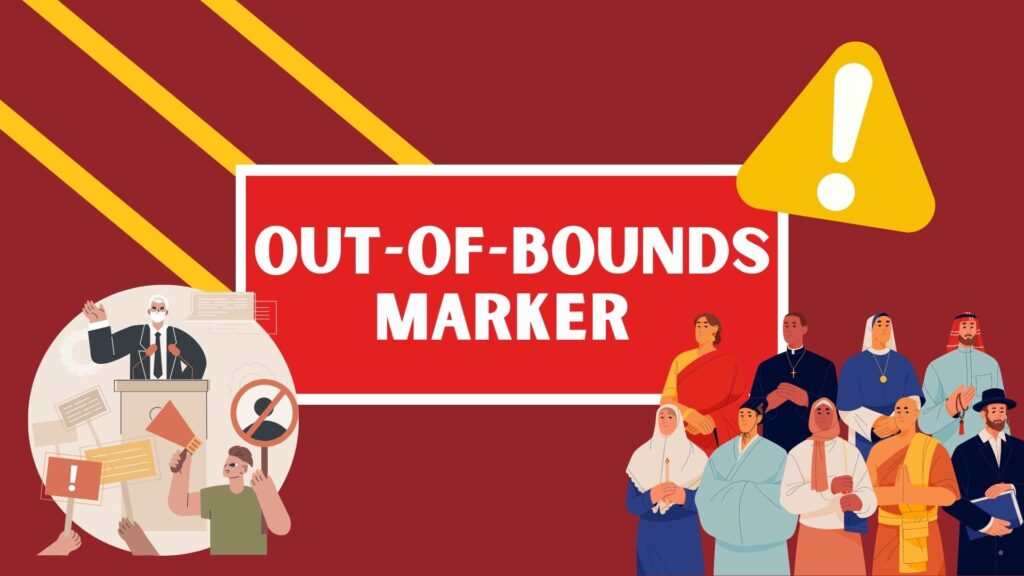
A unique situation regarding censorship in Singapore is the presence of out-of-bounds markers (OB markers). These are matters that the government or other relevant authorities restrict from public discussion, which can range very widely. Examples of such restrictions include contentious issues regarding race, religion, and politics. Singaporean theatremaker and recipient of the Cultural Medallion, Ong Keng Sen explained to The Guardian, in an interview, that “Singaporeans are very aware of where they should align themselves without being told,” and that “you’re not told what’s not possible, but you are given an indication that that’s not the way you should go, and you just internalise it and co-ordinate yourself and your desires.”
We can see that more often than not, these OB markers are an unwritten rule in society rather than a formal policy. The government has put OB markers in place to avoid risking social cohesion in Singapore and preventing its authority from being undermined. The Public Entertainments and Meetings Act (PEMA) mandates the Infocomm Media and Development Authority (IMDA) and the Singapore Police Force (SPF) to suspend or cancel a public entertainment licence if it is contrary to the public interest or inappropriate.
Examples of the Singapore government enforcing such censorship include the cancellation of Swedish black metal band Watain’s concert back in 2019 by the Ministry of Home Affairs (MHA) and IMDA due to concerns over the Satanic nature of the band’s lyrics and past controversial statements that the band had made regarding religion and violence. Supporters of the cancellation believed that the band’s rhetoric would be harmful, especially in the context of Singapore’s diverse society, while others argued that succumbing to the minority here would challenge Singapore’s secular identity.
PROTECTION OR RESTRICTION?
Movies and television programmes featuring homosexual characters or relationships are typically rated R21, regardless of other scenes present. This is in line with the government’s conservative stance on homosexuality or what it considers to be “alternative lifestyles”.
Art does not always need to be pleasant, it can be uncomfortable or provocative with reason. Just like how our lives are not always sunshine and roses, art does not need to be excessively positive. After all, it is a medium for the artist to express their thoughts and feelings about specific issues or the world around them.
Additionally, in 2010, renowned local theatre company W!LD RICE had $20,000 worth of funding cut due to certain projects being “incompatible with the core values” of the government.
One example of a piece of art that is intentionally uncomfortable and prompts the audience to contemplate certain issues is the installation artwork “The Physical Impossibility of Death in the Mind of Someone Living” by Damien Hirst. This piece, created in 1991, features a preserved tiger shark suspended in a tank filled with formaldehyde. Hirst’s artwork elicits discomfort by presenting a large, intimidating shark in a state of suspended animation. The unsettling nature of encountering such a powerful predator up close confronts the fragility of life, provoking reflections on mortality, fear, and the human condition.
Another example is Brother Cane by performance artist Josef Ng, performed in 1994. By preventing artists from making works that depict such matters, we are refusing to acknowledge these issues which once again diminishes the experience for both artist and viewer. Viewers should also be given more ability to judge for themselves, what to consume and what to avoid. Framing viewers’ experience of art will only serve to deprive it of its purpose.
FREEDOM = ART
While censorship in general is important in Singapore to a certain extent, we believe that funding the arts should not be conflated with censorship. The importance of funding leads artists to self-censorship, which restricts their creative freedoms when creating their works. In the long run, this will dull the art scene, creating an environment where artists are reluctant to push boundaries or challenge the status quo. Rather, they will grow to be content with mediocre art that checks all the government’s boxes and secures them funding and ticket sales. If you make art “safe”, regardless of your concerns – moral, aesthetic or otherwise – you extinguish its value.