Written by: Briana Wong, Ho Wen Chen
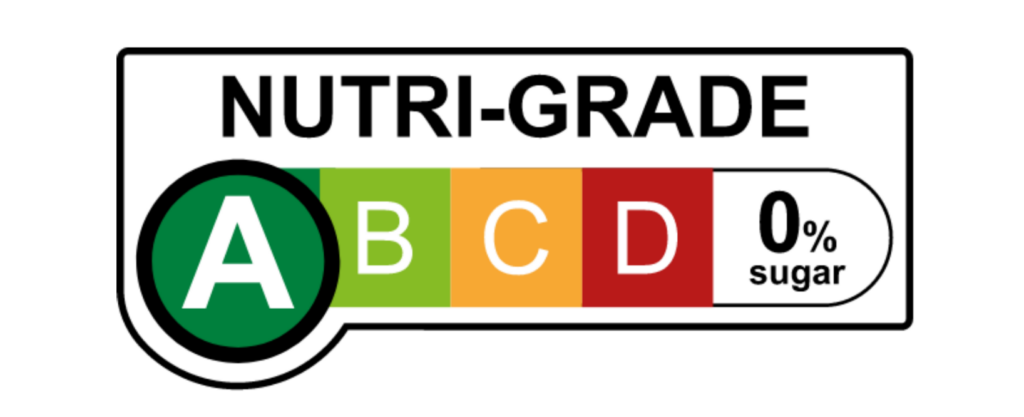
Does this label look familiar to you? You’ve probably seen it before, but what exactly do these Bs and Cs on your drinks mean? These classifications can be confusing at first, but you are not alone! Let’s break down the system and learn how you can make a more informed decision about what to drink.
What is Nutrigrade?
This initiative by the Health Promotion Board (HPB) is a labelling system that uses letter grades to show how much sugar and unhealthy fats are in your drink. With ‘A’ having the lowest sugar and saturated fat content to ‘D’ having the highest, this initiative is meant to discourage people from purchasing drinks graded ‘C’ and below in order to improve their health. This grade can be found on packaged drinks with the percentage of sugar shown next to it, serving as a convenient way to evaluate a drink’s health factor.

Apart from packaged drinks, selected freshly made drinks have also received a labelled grade from December 2023. These labels are on the menu for easy viewing, allowing customers to make informed decisions.
Psst…good news for kopi fans! Kopi contains minimal sugar and saturated fat content and hence receives an ‘A’ grade. According to HPB, drinks with this grade should be made the first choice whenever possible in comparison to drinks graded ‘B’, ‘C’, and ‘D’.
But is Nutri-Grade itself all it’s cracked up to be? We’ll explore its impact, limitations, and how these unassuming labels could help you be healthier!

Nutrigrade’s Impact
According to a CNA commentary in 2024, teens have become more mindful of their drink purchases since Nutri-Grade labels have appeared on drink menus.
Katherine Ang, a 19-year-old student from Temasek Polytechnic, says that the Nutri-Grade system provides consumers a better view of how healthy a drink is and gives them second thoughts about buying drinks that are Nutri-Grade ‘C’ or worse.
“Sometimes, I look at the drink I’m buying and I notice, like, it’s a Nutri-Grade ‘C’, and I’ll put it back, because in my mind, it seems very unhealthy. So I put it back and I purchase something like water or something that’s Nutrigrade ‘B’ and above,” she says.
Students who buy freshly-made drinks, like 18-year-old Nadiah Nazim, have also been impacted by the grade labels.
“Last year, I used to frequently buy a particular drink in a coffee shop, but ever since Nutri-Grade was introduced, I’ve stopped buying that drink. Because it was labelled “C” grade with 7% sugar! Now, I try to buy drinks with ‘A’ or ‘B’ grades,” says Nadiah.
While Nutri-Grade has elicited a more evident change in the consumer decisions of older teenagers, the same may not be so for other consumers. The CNA commentary acknowledges that younger teens have reacted to the inclusion of Nutri-Grade labels differently. In an interview, a 13-year-old student said the labels did not deter him from buying his favourite drink, even with the sugar level and Nutri-Grade displayed.
Limitations of Nutrigrade
However, Nutri-Grade is not an all-encompassing guideline to whether drinks are healthy. This system fails to capture other ingredients that contribute to a drink’s healthiness, such as artificial sweeteners and overall nutrient content. After all, sugar and fat levels are not the only things to look out for in health.
Some known “healthy” drinks can even be labelled as “unhealthy” by Nutri-Grade, as it is only based on their sugar and saturated fat content. According to HealthHub, a digital platform initiative by the Ministry of Health, a can of Coke Zero is a Nutri-Grade ‘B’. Conversely, a 200ml bottle of Meiji Fresh Milk is Nutri-Grade ‘C’, as listed on FairPrice, due to its high saturated fat content. As hard as it is to believe, Nutri-Grade labels the non-nutritious Coke as a ‘healthier’ drink than calcium-rich milk!
As such, some may misinterpret the label as an exhaustive guide to whether a drink is healthy instead of looking at the entire picture.
Nadiah says that the most important thing to note is how often “less healthy” drinks are consumed rather than avoiding them completely.
“I don’t think the system is completely effective. Just because a food item is higher on the grading system doesn’t mean it should be consumed frequently. Everything should be enjoyed in moderation and it’s best to stick to homemade meals or water.”
Nadiah also notes that drinks with a ‘better grading’ are not necessarily healthy as well.
When purchasing a drink, it is important to note all the factors that contribute to the drink’s health benefits and detriments. Other labels, such as the Nutrition Facts Label, and Healthier Choice Symbol, can also lend us an idea of how healthy a food item is. It is hence essential to be familiar with what each of these labels represent in order to make more informed consumer decisions.
A New Initiative With Room For Improvement
As a relatively new initiative, Nutri-grade’s long-term impact is still being assessed. While the results so far are promising, more research is needed to fully understand its effectiveness in influencing consumer behaviour and ultimately, improving public health.
Nutri-Grade is most effective when viewed as part of a comprehensive public health strategy and should not be the only initiative we pay attention to. HPB’s efforts to promote healthy eating habits through education and other initiatives alongside Nutri-Grade can significantly encourage healthy lifestyles for all Singaporeans.
However, this effort requires a two-way street. The effects of these initiatives are better shown when a conscious effort is made to lead a healthier lifestyle. Choosing drinks with lower sugar and saturated fat content is only a step in the bigger picture. Increasing physical activity, eating healthier, and valuing your mental health are all ways to improve your quality of life! By combining these aspects, the public health message becomes more nuanced and empowers us to make informed choices that contribute to our overall well-being.
Ultimately, Nutri-Grade is a valuable piece of the puzzle when it comes to promoting healthier beverage choices. While it has its limitations, you can maximise its benefits by viewing it as a positive step towards a healthier population. It is true that success lies not in being a standalone initiative, but in contributing to a bigger picture of public health awareness and informed decision-making. So the next time you buy a drink, pay attention to that little label!