

Written by Ellyne & Shanmuga
Owning a furry friend can be an exciting adventure! From fishes and rabbits, to dogs and cats, animals can have such a great impact on our lives. In recent years, there has been an increase in pet ownership in Singapore. According to NParks, in 2018 there were 2794 pet imports in Singapore and it was mentioned by Euromonitor international that in 2019 the dog population in Singapore reached 111,500. According to The Society for the Prevention of Cruelty (SPCA) there was an increase in foster application from 10 to 15 a month to 120 to 150 during the circuit breaker. This proves the pandemic has only made people more interested in owning pets.
However there are many challenges that come with owning a pet. Be it government laws or daily expenses, there are many obstacles that hinder our impulsive decision to grab a furry friend from the nearest pet store.
These factors are even more predominant in regards to dogs. So is Singapore really dog friendly?
It would be fair to say that dogs are well known to be man’s best friend. Of which may stand true for many. They were trained by humans to guard, herd and accompany; and have evolved with us, to learn to live in our lives. However, there are many breeds who have been trained to fight and hunt, leading to aggressive behaviours which are not welcomed by Singapore’s laws. Breeds like the Akita, Pitbull and Perro de Presa Canario are some of the breeds banned in Singapore. Not only that, breeds like the Doberman Pinscher and German Shepherd are under close scrutiny by the Singapore government.
Even if a dog breed may pass border control, there are only a few dog breeds that are approved by the Housing Development Board (HDB) and allowed into our homes. For potential owners looking to own a dog in an HDB flat/apartment, breeds like the Golden Retriever and even the Welsh Corgi are off limits. Here is the list of HDB approved dogs.
Naomi Quentin is the owner of Cruiser – a corgi-husky-chow chow mix, and she faced difficulties while getting her dog since he was not in the list of HDB approved dogs.
“For me I live in an HDB and when I first went to the store, I completely ignored cruiser since he was not HDB approved. Thankfully after my parents picked him up and asked the seller, we found out that actually, he can stay in an HDB, just that we have to get a special license for him from Animal and Veterinary Service (AVS). I feel that this is something to consider when getting a dog.”

She also mentioned the laws and regulations that need to be followed when taking her dog out.
“I did not realise that my dog has to be leashed at all times when we are out. This took a while for Cruiser since I needed to get him leash trained. I also have to be aware that he has a special license so if he does anything and harms anyone, that could mean that we could be fined or he could be taken away from us – which would be a nightmare for me. ”
Other than laws and regulations, there are other factors to consider when it comes to owning a dog – such as land space.
Singapore is known as the little red dot, with a land area of only 728.6 km^2 (728.6 squared kilometers). As such, about 80% of Singaporeans live in HDB flats since most Singaporeans live in apartments like HDB flats and condominiums due to this lack of land area. These apartments are small as well. According to Yahoo Finance, based on 2018 resale transactions, the average area size of a 5-room flat across HDB estates across the island is around 1,280 squared feet (118.9158912 squared metres). However, an average dog requires a backyard space of around 232 m^2 (232 metres squared). This limited space is the reason why many dog breeds are not allowed in HDB apartments.
To be a dog owner comes with its own set of challenges. An active lifestyle and a lot of attention is needed to properly care for your dog. Tasks like taking your dog out for a walk, getting up early to cook and feed them, teaching your dog manners and bathing them can take a lot of time. If you are someone who is a workaholic and can’t dedicate proper time for your dog, it is recommended you don’t get one full time.
Another part of owning a dog is making sure the environment is dog ready. That includes making sure your house and car are dog-proofed so they cannot escape. In the car, there needs to be a transport box, safety belt, and a car seat cover for your dog
“It’s fun. You get a friend and emotional support, though I get less time to myself. [I] need to consistently take care of the dog, bring it for walks and feed it everyday, so I have more things to do everyday” said Joey Ong, 19.

Getting a pet can come with a whole set of extra expenses depending on multiple factors. You can either choose to buy a dog from a reputable shelter or adopt one. Buying one can cost a minimum of $2500. Adopting is the cheaper alternative – costing anywhere from $180 – $350; but the process can be more tedious as it requires more paperwork and a number of home visits. Other than getting the dog itself, there also comes yearly expenses, like checkups, food, toys and grooming. All of these can incur a hefty $3000 per year average.
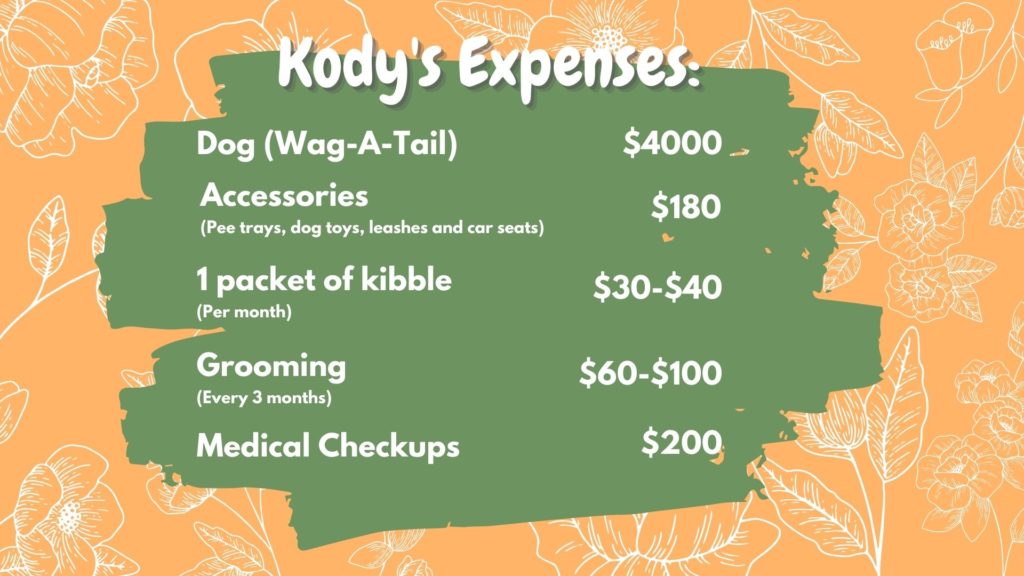
For Joey, who owns a maltese named Kody, the dog itself cost her $4000 from Wag-A-Tail. Upon getting him, accessories like a pee tray, dog toys, leashes and car seats cost her $180. On a monthly basis “For food, 1 packet of kibble costs around $30-$40. For my dog, that’s enough for one month since he’s small. Grooming can cost, on average, $60-$100 every 3 months or so. Medical checkups cost about $200 but can cost more if any additional treatment is needed.” she said.
Overall, getting a small dog may be the best fit, especially in the busy city of Singapore. Make sure to do research on what dog breed suits your lifestyle the best, and consider factors like your occupation, income, and household members. Having an active lifestyle is also important for a dog. So if you want to get a dog, consider being more active or engaging in more outdoor activities.
Unable to get a dog but still want to interact with furry animals? Volunteering is always an option. Here is a list of dog shelters that you can volunteer at depending on your preferences. For a short term solution, fostering can also be an option. Fostering stray dogs until they find their forever home can be very fulfilling. Fostering stray dogs helps save dogs from living on the street and culling. However, do note that it is important to always consider the environment and your lifestyle! Is it ready for a furry friend?
If it is, check out SOSD Singapore, which has a fostering programme for dogs.
We hope you have found this article useful in informing you more on the pros and cons of getting a dog in Singapore!