
By Ellyne Chin & Joelle Tan
Ever heard of the saying “Breaking a mirror brings 7 years of bad luck”? Stories like this are common superstitious tales told by parents to their children. However, what exactly is a superstition?
According to the Oxford dictionary, the definition of superstition is “a widely held but irrational belief in supernatural influences, especially as leading to good or bad luck, or a practice based on such a belief.”
Superstitions are often used to give advice on good fortune or are cautionary tales. Despite the lack of scientific proof, many people still hold on to these beliefs.
Still, where do these tales come from? According to Chloe and Kady, hosts of the “Can’t Breathe Podcast” which explores Asian horror and crime stories: “Superstitions are created when a specific set of actions concludes to the same results. Making it hard to dismiss as simply a mere coincidence or sheer bad luck.” They explained that although some superstitions might seem illogical, people still tend to adhere to these beliefs as following such superstitions cannot do more harm than good. So why risk it?
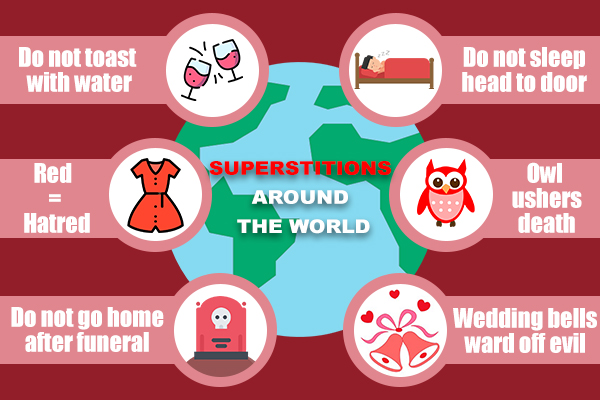
Here are some intriguing superstitions around the world that we thought you should know about.
- Red is the colour of hatred and anger: Singaporeans believe that if you pass away wearing red, it symbolises vengeance and you will come back as a revengeful ghost.
- Do not toast to water: Germans believe that if you make a toast with water you’re actually wishing death upon the people you’re drinking with.
- Do not go straight home after a funeral: A Filipino tradition called “pagpag” dictates that people should never return straight home after a wake. Otherwise, a malevolent spirit might tag along and come inside. Mourners usually make a stop at a restaurant or store first just in case.
- Avoid sleeping with your head directly facing the door: According to Japanese superstition, sleeping with your head facing this direction is bad luck as that is how the deceased are laid to rest in a morgue.
- An Owl in your house ushers death: This Italian superstition says that if an owl ends up in your house, someone in your family will die soon.
- Wedding bells ward off evil: Irish brides have been known to wear bells on their dresses to ward off evil spirits who might try to ruin their marriage
Many superstitions being circulated tend to be of darker natures. When asked to clarify why, Chloe and Kady explain that the ones many are more aware of tend to weigh towards the darker nature as the majority of it ties in with the supernatural.
Just like for some of the examples above, people abide by those superstitions to avoid contact with the supernatural.
All over the world, different countries, cultures, and religions have various different takes on superstitions. This means that sometimes, superstitions could contradict each other. For example, Chloe and Kady elaborate that the meaning of the colour red is different for different occasions.
“For example, when you see a spirit dressed in red, it usually symbolizes vengeance. However it is also believed in Chinese culture that the colour red is auspicious and very huat. Like how we dress for CNY.”
Another example of contradiction in superstitions is the nature of the number ‘4’. In some countries like Germany, the number 4 is a lucky number as it represents the four-leaved clover. Whereas in Chinese cultures, the number 4 has a similar pronunciation as the word death (si). As such, which superstitions you follow depend on which country one is in and adapt accordingly.
Superstitions have lived as tales passed down for generations and are not going anywhere soon. While there is no concrete proof of the truth behind superstitions, there is no harm in believing in a little bit of luck.